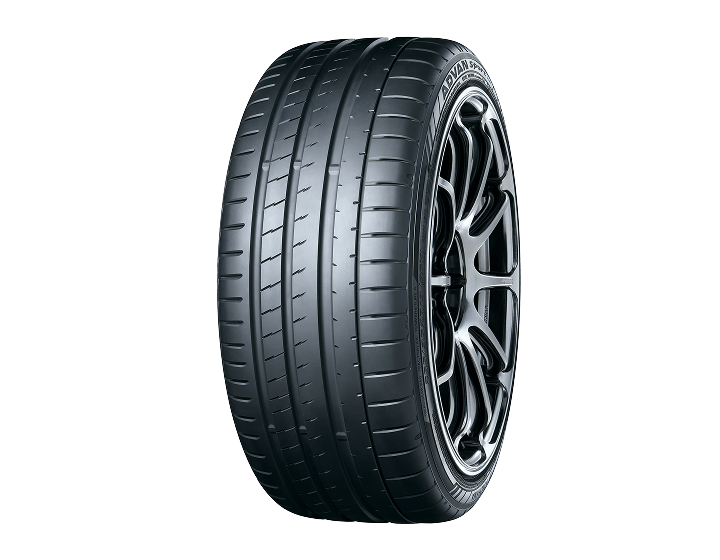
ADVAN SPORT A/S+


Since 2012 the EU Tyre Energy Label provides a clear and common classification of tyre performance for rolling resistance, braking on wet surfaces and external noise. The labels help consumers make informed decisions when they are buying tyres as they can easily set their priority choice based on the parameters.
Regulation (EC) No 1222/2009 first introduced the obligation of placing car and van tyres on the EU market with a sticker showing the label. That regulation was repealed and replaced by Regulation (EU) 2020/740 with start of application on 1 May 2021. It established a framework for the provision of harmonised information on tyre parameters through labelling to allow end-users to make an informed decision when purchasing tyres, for the purpose of increasing economic and environmental efficiency of road transport by promoting fuel-efficient, safe tyres with low noise levels.
Tyres are no longer allowed in classes F and G for rolling resistance and for wet grip, which is why the new scale has only 5 classes (A to E). The new energy symbols better suggest that the fuel efficiency is applicable to both internal combustion vehicles and to electric ones. In the bottom part, the external rolling noise class is always indicated, including the measured value of external noise level in decibels.
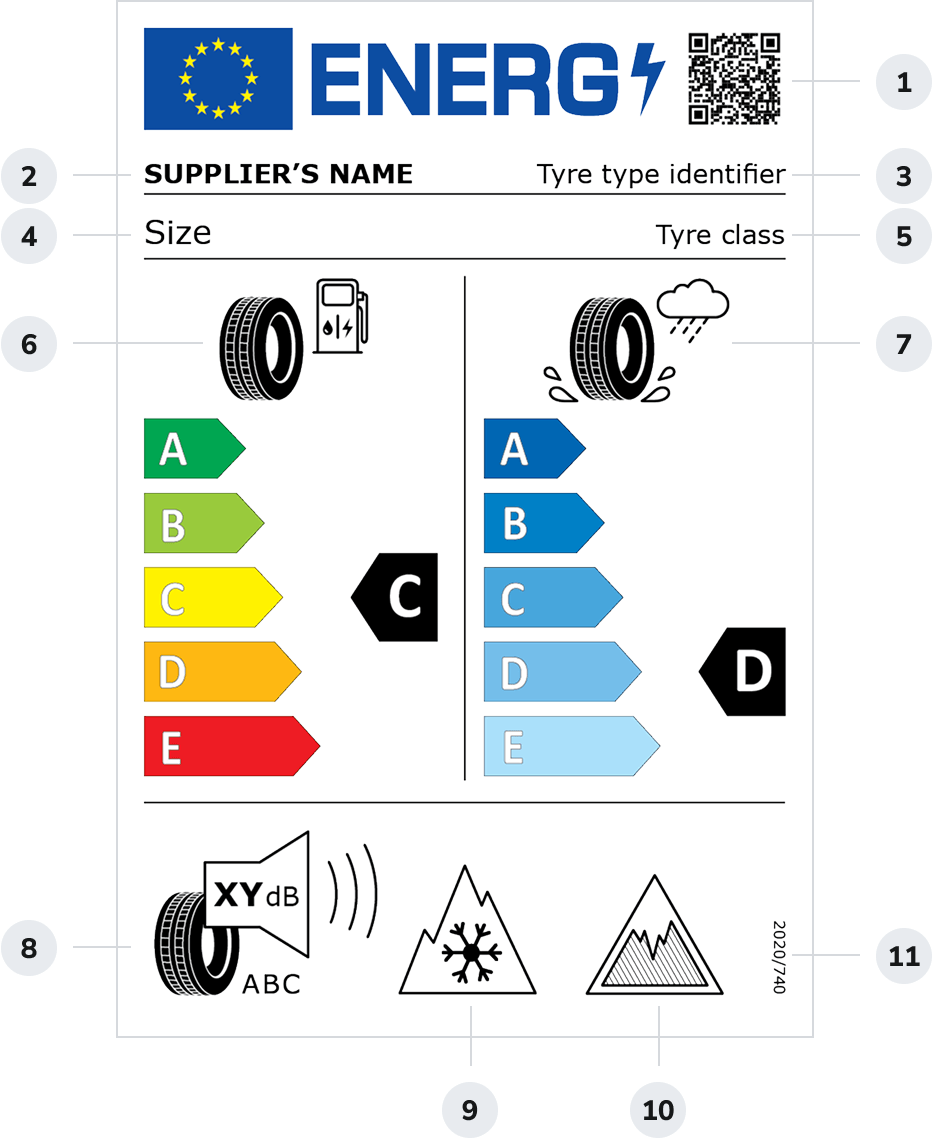
The fuel efficiency class ranges from A (most efficient) to E (least efficient). A top class tyre has less rolling resistance and therefore requires less energy to move the vehicle. This translates into lower energy costs (fossil fuels or electricity).

The wet grip describes a tyre’s performance under wet conditions and its classes ranges as well from A (shorter braking distance on wet asphalt) to E (longest).
The external rolling noise class ranges from A (less noise outside the vehicle) to C (highest noise). The external rolling noise, caused by tyres, is measured in decibels. This noise is different from the
“cavity noise”, which is the noise transmitted from the rims to the interior of the car.
Under the new regulation, in addition to the previous tyre label, there are also options for including an icon relating to grip on icy conditions and/or severe snow conditions in the bottom part of the tyre label (next to the external rolling noise pictogram) for tyres which satisfy the minimum snow grip index values or the relevant minimum ice grip index values.
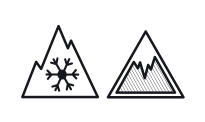
Tyres suitable for severe snow conditions bear the snow grip pictogram (“3 Peak Mountain Snowflake”) or “alpine” symbol that is also present on the sidewall of such tyres. Nordic winter tyres (tyre class C1) for use on iced surfaces will feature a symbol (ice grip pictogram) that represents an ice stalagmite.
The QR code, to read with a smartphone or other suitable reader, is intended to provide this and additional information for each individual tyre type identifier via a link to the public part of the new European product database for Energy Labelling (EPREL). A link to this database is also provided via the YOKOHAMA website (www.yokohama.eu). You can also get the information of the database in printed form from your tyre dealer.
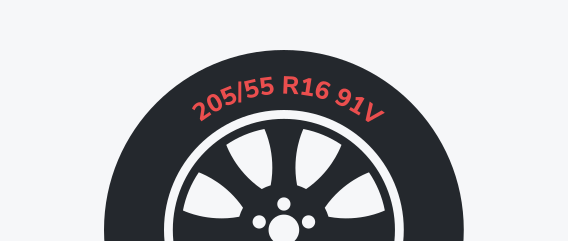
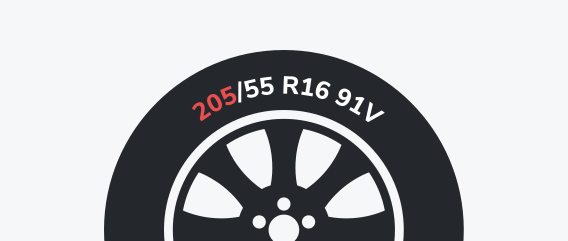
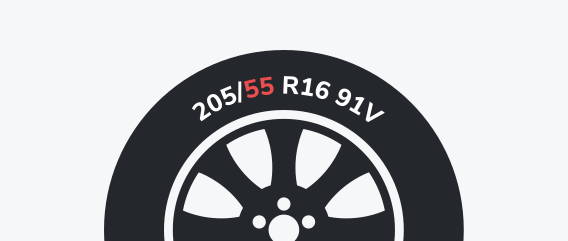
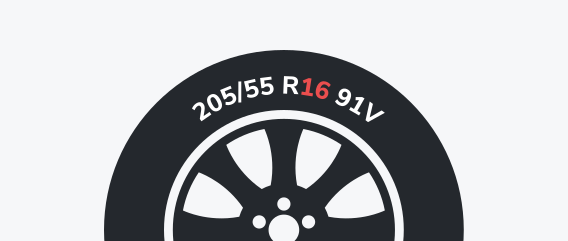
Other components of the label are the trade name or the trade mark of the supplier, the tyre type identifier, the tyre size designation, the load-capacity index and the speed category symbol, the tyre class and furthermore the serial number of the regulation (in the bottom part of the tyre label).
Discover how tyres are rated for grip, efficiency, and noise under the latest EU regulations.